Vibe trolling
I have already started talking about Trolls Farm. There are two camps on a symmetric map, and your task is to collect more resources than your opponent. As always in strategy games, you have to balance strategy and tactics. You can plant a lot of trees, collect a lot of fruit, and train a super power troll. But by the time you do that the game may already be ending, and your mighty troll will have no time left to collect resources.
Let us make this a question-and-answer session.
Why vibecoding? Because, unfortunately, I do not have enough time to write all the code myself. At the same time, optimal system management is a very interesting topic to me.
Why spend time on this at all? It is an interesting task at the edge of contemporary agentic programming abilities. It is also a good opportunity to compare OpenAi Sol with Fable.
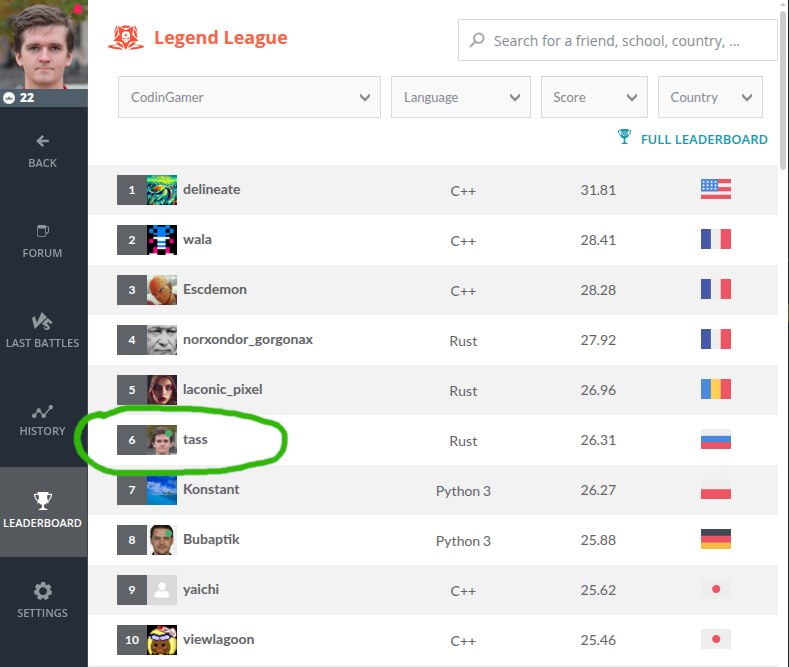
And what? Fable stopped at 135th place, Sol super max brought me to 6th place in the global rating.
How should you approach a task like this? Give the agent tools for working with the platform: compile the code, submit it to the arena, and read the current position in the leaderboard. You do not need to run an MCP server. All the models can figure out the API and use it. Codex does this faster. Claude usually needs to be explicitly told to investigate the API and write the tools down.
Just run agent and wait? Not quite. It can give you the first prototype, but after that you have to keep pushing the development toward higher places.
What works? Analysis of recent battles. Looking for recurring weak points across a series of games. Numbers, statistics. Idiotically simple, but deep models of the world, like "gain per turn" for resources, which allows to write down a simple expression like tree_gain / round_trip_length and select goal according to this expression.
What doesn't work? Manual watching games and making guesses: "Plant more trees near the camp, use seeds to train powerful trolls!" It gives you +5 wins and +15 loses. Thinking about super complex algorithmic approaches and attempts to implement something, which "automatically finds the best moves just out of the game rules"
Do you feel satisfied? Not quite. Now I understand programming multiagent systems slightly better, but now I want to make a close analysis of the program, main ideas, moving parts. So stay tuned, the case is not closed yet.