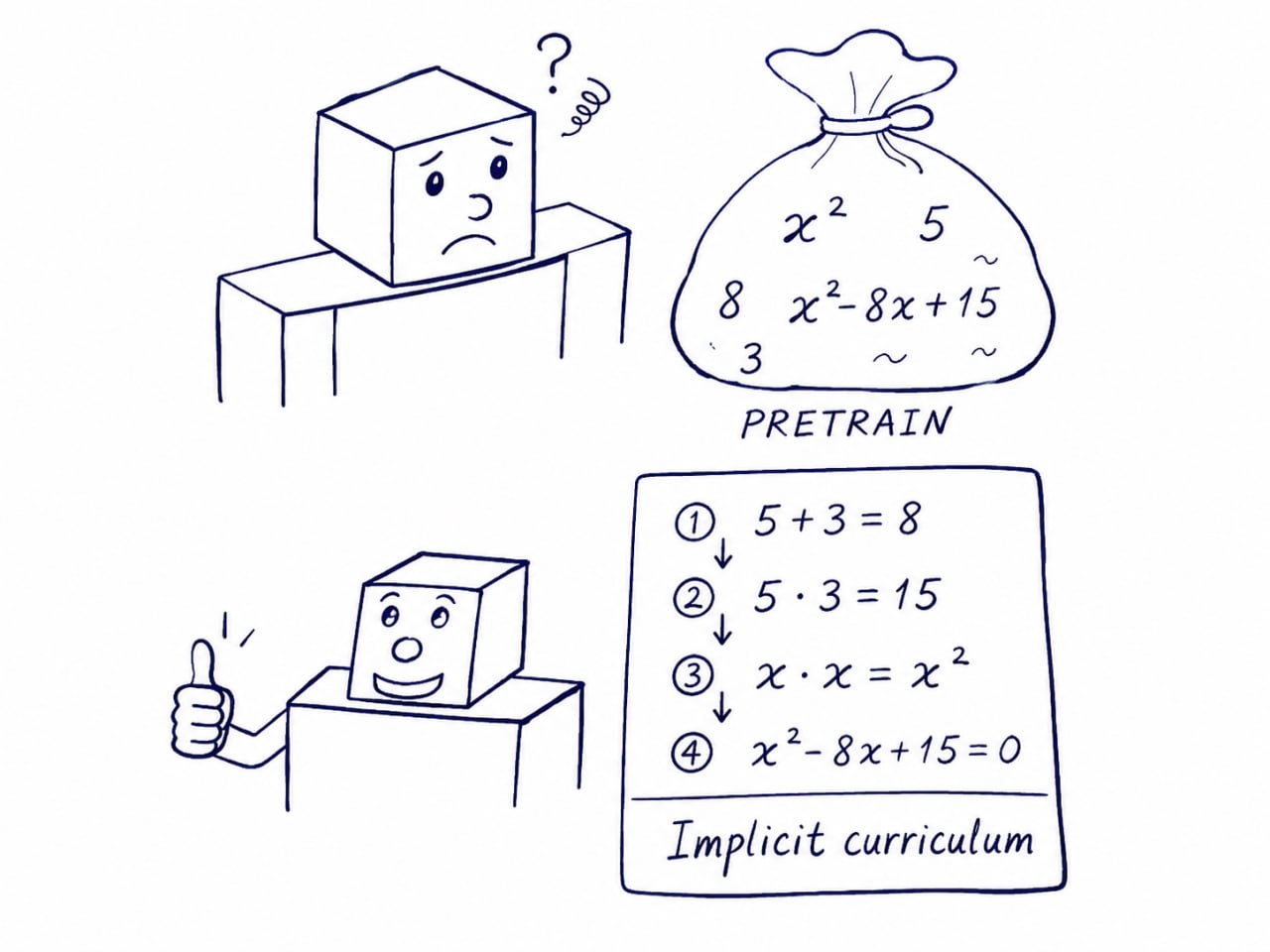
Implicit Curriculum aka skill graph
Why should I read all these articles? - I asked myself this week, when I suddenly found this diamond.
To explain why I jumped out of my chair, let me tell you about my previous team. It was Schoolbook. My second assignment after I joined it was to figure out how to build, store and edit a skill graph. It is quite an intuitive idea: in order to solve quadratic equations, you have to understand square roots, summation, multiplication and so on. These simple skills are prerequisites. You can represent these dependencies using a DAG (directed acyclic graph). There were a lot of professional teachers who built mathematics and Russian language graphs in our team. While the idea seems quite straightforward and intuitive, its implementation is the opposite of simple and clear. It took me half a year to understand how it should work and how to implement it in a production environment.
But what about the article? It gives a nice landscape of how skills emerge during model training on unstructured internet data. The described articles give important understanding of how skills emerge in large language models, how to evaluate them, how to detect phase transitions in a model and how to find internal representations of skills inside the model.
For me, these findings are very important because they are very close to the bridge between model training and human education. I believe that our brain is just a very complex classical computer and that insights can be transferred from human education practice to machine learning and back. After reading the article, I feel much more confident that the skill graph is a real thing, not just a figment of our teachers' imagination.
There is quite a well-shaped method of model evaluation. Probably, it can be transferred to the realities of educational platforms and give us metrics for educational efficiency.