
Levels of liquid in a Markov process = PageRank
This post is a compact version of what happened in a neighboring chat. Sorry to newcomers who already read it — and welcome!
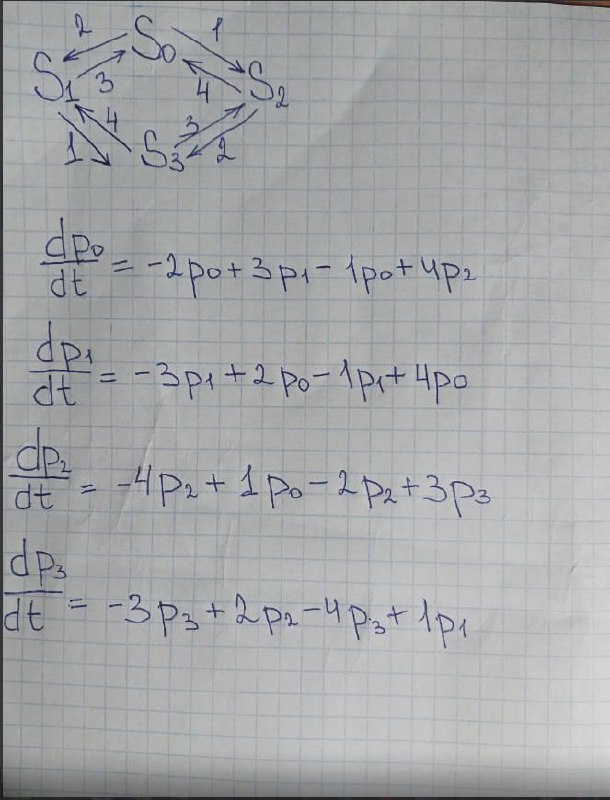
The first two pictures are from a student who was wondering why we suddenly put zeroes on the right-hand side of the equations. The student was totally disoriented, because they called it “normalization”.
Here’s the idea.
A stationary situation is the one where nothing changes in time, i.e. all time derivatives are zero. So it looks like we have four equations for four unknowns and we can just solve them. Not yet.
When the original problem is a Markov process with transition intensities/probabilities, you can read it as a physical model:
🫙four jars (states),
🚰 tubes between them (directed edges),
💨 flow through each tube is proportional to the “pressure” in the source jar (so yes, a weird viscous toy model).
Physical intuition: the system relaxes. After some time, the levels stop changing — inflow equals outflow for every jar. Those “asymptotic probabilities” are exactly the stationary distribution.
Now the important part: liquid can’t appear or disappear. Total amount is conserved. Because of that, the balance equations are linearly dependent: one of them is redundant. That’s why you cross out one equation and replace it with the conservation law:
p₀ + p₁ + p₂ + p₃ = 1
That’s the “normalization”. It’s not some mystical extra trick — it’s just “total liquid is 1 m³”.
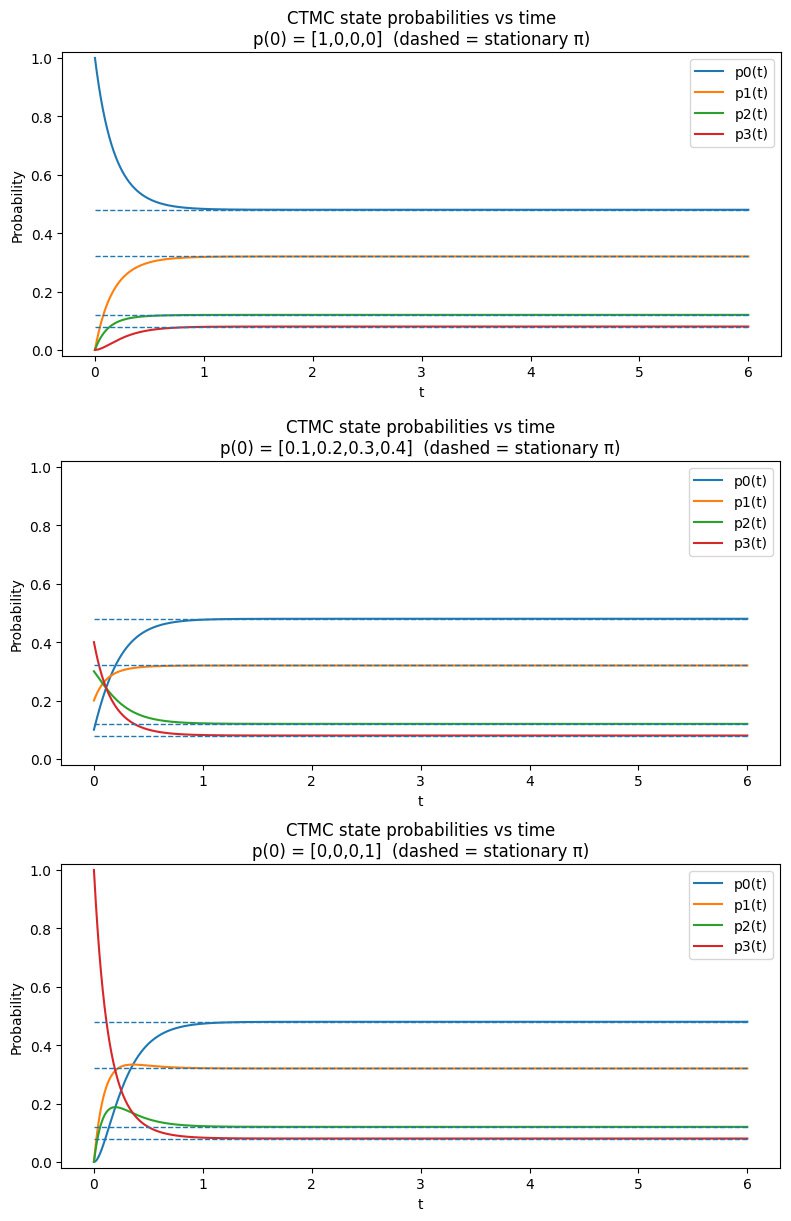
The third picture shows the result of numerical modeling for different initial states. You can clearly see the relaxation stage and then convergence to the same stable solution (dotted lines).
And here comes the nice historical echo. ~30 years ago, Larry Page and Sergey Brin solved basically the same stationary-flow problem on the web graph: links became transition probabilities, and the stationary distribution became a ranking score for pages. This approach is called PageRank — not because of “pages”, but because of Larry’s family name.
It worked amazingly well for the early Internet (when “a link is a vote” was closer to truth), and it helped Google rocket. It’s not the whole story of ranking anymore — but as a first big scalable idea, it was a game changer.