New school level physics problem
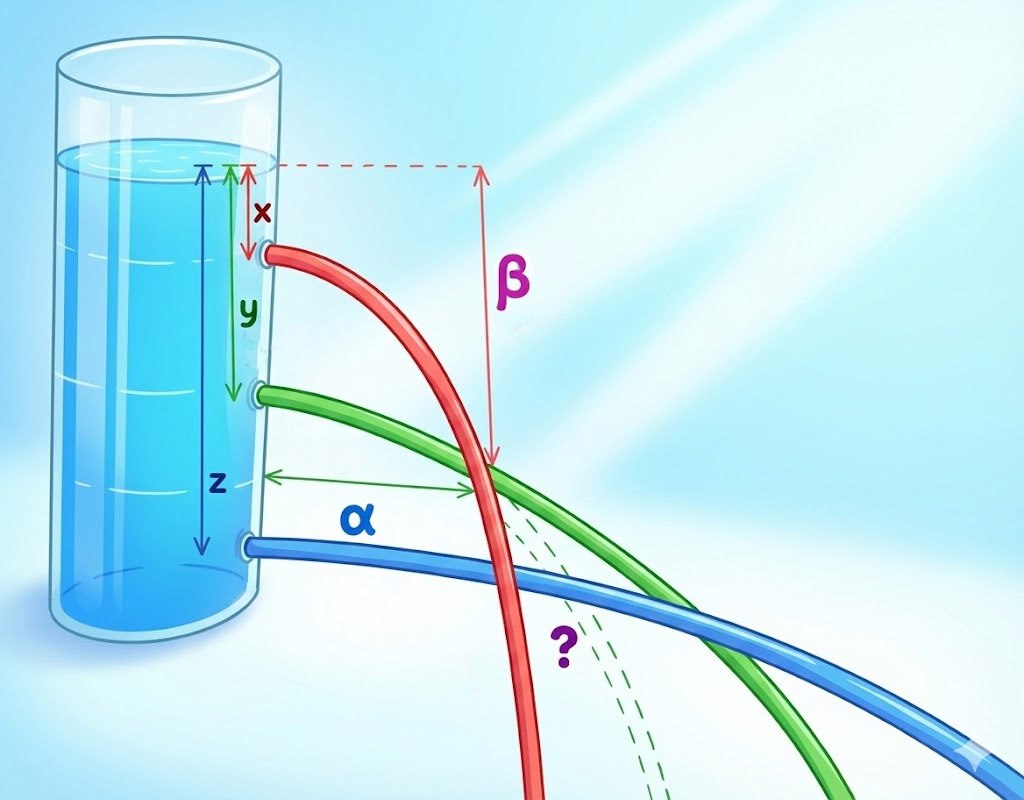
There is an old physics problem: two holes in the wall of a jar with liquid. The depth of the first hole is x, the second is y. You are to find: the horizontal distance from the jar wall to the point where the two jets intersect, and the vertical distance from the liquid surface to that intersection point.
It’s an ancient problem — you can find versions of it already in Torricelli’s works, where he derived the expression for jet velocity.
But if you slightly extend it — add one more hole at depth z, assume all holes have the same cross-section, say that the two jets merge after they meet, and then ask for the intersection point of the merged jet with the third one — hurray! You get a new physics problem, one that (as far as I know) isn’t in schoolbooks yet.
The answer to this new problem is not as simple and elegant as in the original one, but it’s still totally doable. And it’s also a nice excuse to discuss which conservation laws you can apply to the “merging” process — and which ones you can’t, and why.