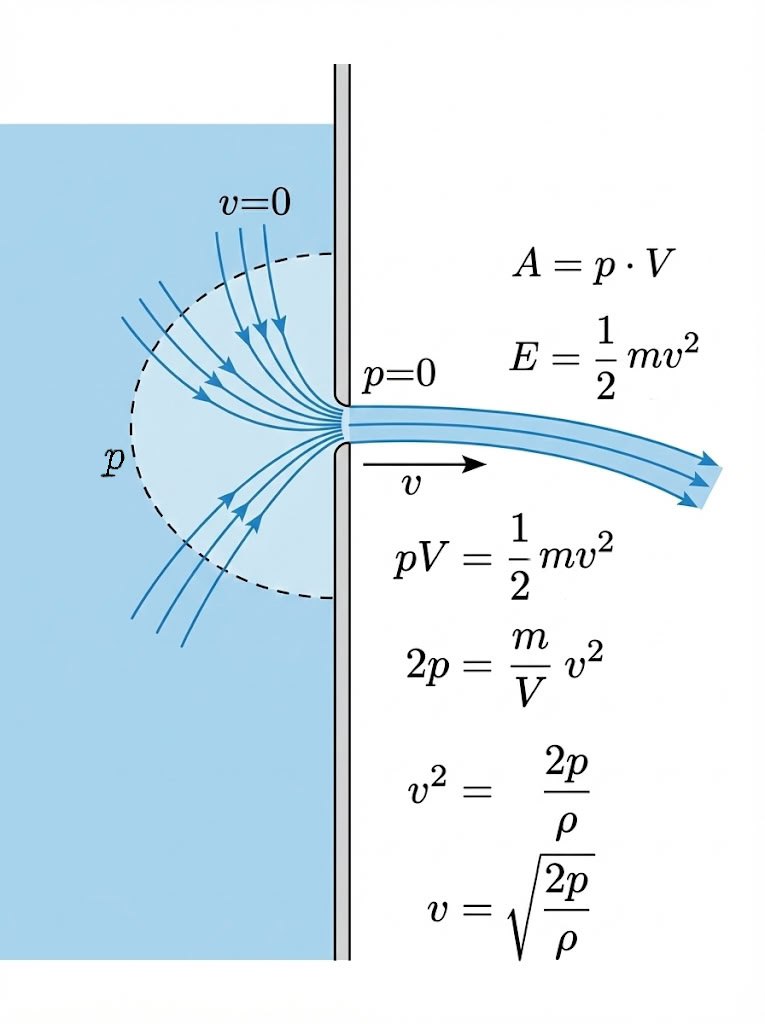
Pouring-out velocity
When solving physics problems at school, I used a standard formula for the velocity of a jet pouring out of a hole, given the pressure inside the liquid and its density. But for a long time I couldn’t really derive this expression myself. And now I understand why.
The picture was inconsistent.
The equations themselves are trivial. On one hand, one can write energy as 𝑝𝑉. On the other hand, kinetic energy is ½ m v². So one writes pV = ½ m v². Using ρ=m/V, we immediately get a nice expression for the jet velocity (the whole thing is in the picture).
The problem is conceptual. There is no such volume whose one side is under pressure 𝑝, whose other side is under pressure 0, and which simultaneously accelerates from 𝑣=0 to v=v0. In school and even at university I felt this discrepancy intuitively, and because of that the derivation always felt like a trick rather than understanding.
Twenty-five years later, something suddenly clicked. It seems, I got it. An illusion, of course. Let me share it.
First: the streamtube.
A streamtube is an imaginary tube with an inlet, an outlet, and walls. The walls are formed by streamlines — curves tangent to the velocity of the fluid at every point. This construction is powerful because it lets us write an energy balance between inlet and outlet.
Crucially, there is no work done on the walls: pressure forces are perpendicular to the walls, motion is tangent to them, and the dot product of perpendicular vectors is zero.
So what is really going on?
Deep inside the liquid, the fluid is almost at rest and the pressure is maximal: 𝑣=0, 𝑝=𝑝0. At the center of the hole, the pressure is zero and the fluid has some non-zero velocity 𝑣, which we want to find.
One quantity smoothly transforms into the other as we move from the bulk of the liquid toward the hole. Let’s consider a streamtube that goes from the center of the liquid volume to the hole. Now everything makes sense.
The inlet of the streamtube is much wider than the outlet. That automatically gives us (almost) zero velocity at the inlet and a finite velocity at the outlet. We are no longer talking about a tiny abstract volume — we are considering the entire volume of liquid inside the streamtube.
This volume accelerates under the action of pressure gradients. It plays two roles at once:
◦it is a body that accelerates under force, and
◦it is a lever that multiplies liquid velocity by the ratio of inlet to outlet cross-section.
The resulting picture is a bit crazy: a mushroom-like shape, with many tubes narrowing from the “hat” to the “leg.” Liquid accelerates along these tubes; work done at the beginning is exactly balanced by work at the end of each tube. Complex — but internally consistent.
Basically, we have followed the university-level route that usually leads to the Bernoulli integral — but done it at a school level. And now we have a “magic-free” derivation of the pouring-out jet velocity.
And this is just moving liquid. In the simplest possible case: liquid pouring out of a hole.
But then come vortices. Plasma. Mass transfer coupled with electromagnetic fields…
Yummy craziness.